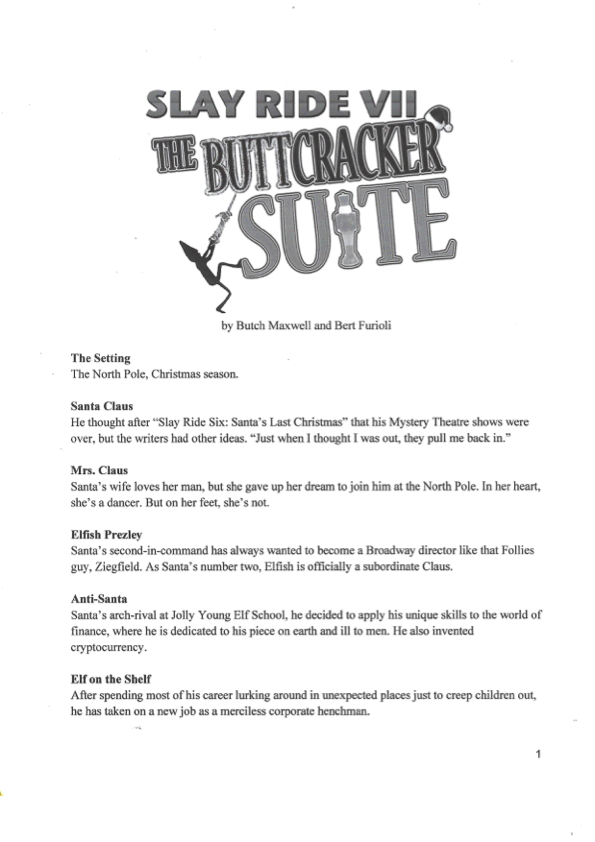
The last script Bert wrote for Mystery Theatre Unlimited was called The Buttcracker Suite. I want to start there, because I never would have called a show that. I have plenty of bad taste in me—MTU wouldn’t exist otherwise—but I flinch before I commit to it. Bert didn’t flinch. He’d land on a title like that and have three jokes built around it before I could get a word out. By the time I caught up to object, there was nothing left to object to. The bit had already justified itself. He wrote it in October 2024, typed out on a phone with two thumbs, because that was how we worked by then. He still called it The Buttcracker Suite.
That was the whole partnership, twenty-nine years of it, compressed into a title. I was the one who slowed things down, who asked whether a joke earned its place or just wanted to be there. Bert didn’t ask. He trusted the laugh to arrive before the judgment did, and mostly he was right.
I used to think of this as a difference in taste. It wasn’t, not really. It was a difference in nerve. And for a long time I assumed that nerve was the fragile part—that the vulgar, audacious, of-this-exact-moment joke was the one that wouldn’t last, and my caution was what kept the shows alive long enough to revive. I was half right. The specific reference does date. What I got wrong was assuming the nerve went down with it.
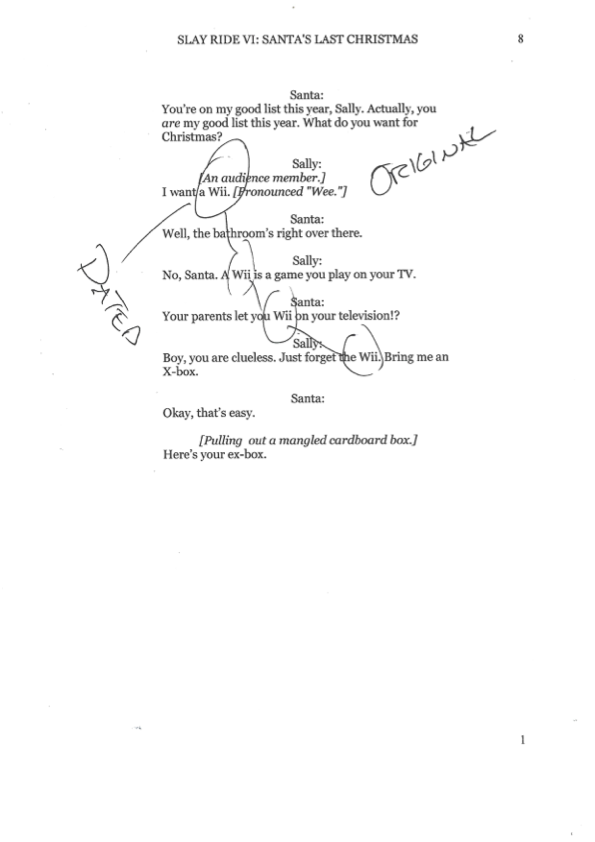
Here’s the proof, and it’s a good one, because it’s the same joke twice. In Slay Ride VI: Santa’s Last Christmas, an audience member tells Santa she wants a Wii—pronounced “we,” the way a kid would say it before the console existed in the popular imagination. Santa hears something else and points her toward the bathroom. She corrects him: it’s a game you play on your TV. He asks, not unreasonably, whether her parents really let her Wii on television.
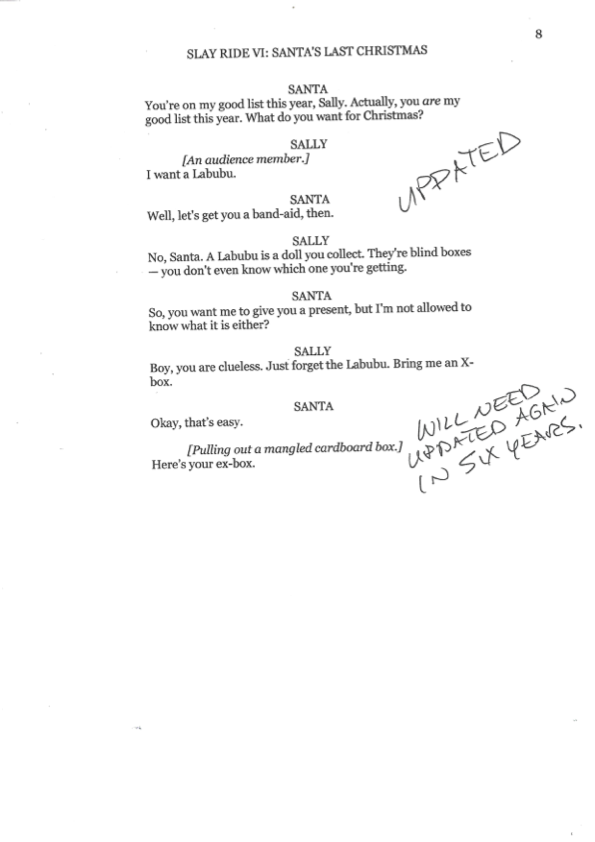
That joke died. Not badly—it worked in its moment—but a Wii is not a thing anyone under twenty has a relationship with anymore, and the confusion at the center of it stopped landing. When we revived the show a few years ago, the reference changed. Now it’s a Labubu: a blind-box collectible doll, the audience member explains, you don’t even know which one you’re getting. And Santa’s line changes with it—so you want a present, but I’m not allowed to know what it is either.
Same structure. Same misheard-word setup, same deadpan turn, same rhythm of confusion resolving into a slightly better joke than the one you thought you were getting. I didn’t have to touch the mechanics. I swapped the reference and the bit was exactly as funny as it had been thirteen years earlier, to a different set of nine-year-olds who’d never heard of a Wii. That’s what I mean about the rhythm surviving. The joke was never really about the toy. Bert built it out of something underneath the toy, and the toy was just whatever happened to be sitting on the surface the year he wrote it.
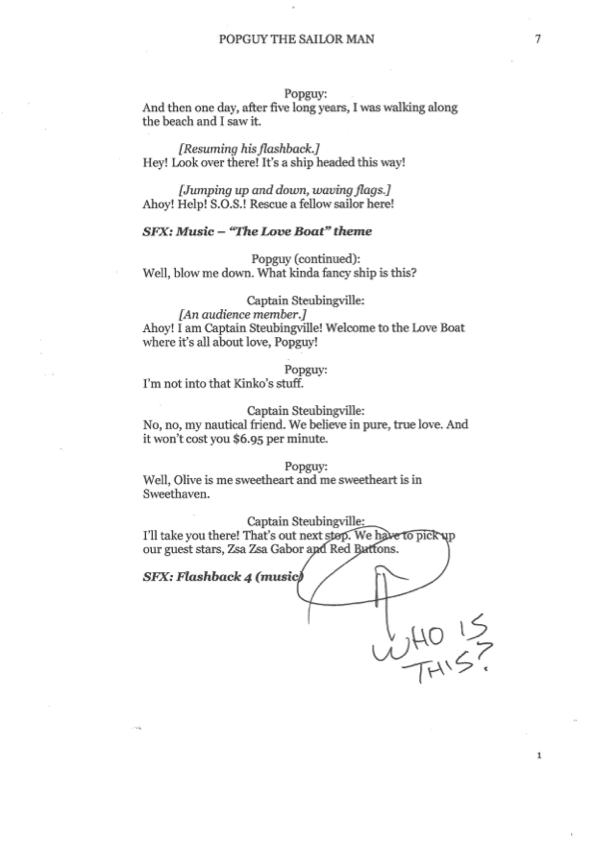
Not everything survived that cleanly. In 2018, in Popguy the Sailor Man, Bert wrote a Captain Stubing type—straight out of The Love Boat, itself an old reference even then—who announces he’s picking up his guest stars, Zsa Zsa Gabor and Red Buttons. It got a modest, knowing laugh from the older half of the house. My younger cast members had a simpler reaction: who the hell is Red Buttons?
That joke didn’t get updated. Instead, something better and stranger happened to it: the company started using it as a name. Any time a very dated reference turned up in a script—new or revived—somebody would flag it as “a Red Buttons.” It became shorthand, then a running joke of its own, then just vocabulary. Bert was alive for that. He heard people say it about his own lines, and he loved it. He would have defended the original joke completely on the merits—the not-knowing was the point, he’d say, that’s the whole bit, you don’t explain a Red Buttons, you let half the room laugh and let the other half feel the shape of the joke going by without them. He wasn’t wrong about that either. A joke can be built entirely out of a generational gap and still be a real joke.
But you don’t want to have to explain a joke to half an audience. That was my side of it, twenty-nine years running, and neither of us ever fully gave ground. He kept writing references built to expire. I kept catching them on the way to the stage, some of them, not all of them, and missing plenty. We never resolved it, and I don’t think either version of us was trying to. It was just the argument the partnership ran on.
I’m writing MTU scripts alone now, and I’ve had to notice which half of that argument I actually am, absent the other half to push against. I catch myself flinching at things nobody’s making me flinch at. I hesitate at titles I’d have talked myself into if someone across the table had already committed to the bit and left me nothing to do but fix it. I don’t think I write worse alone. I think I write more carefully, which is not the same compliment.
“I don’t think I write worse alone. I think I write more carefully, which is not the same compliment.”
What I keep coming back to is that the two failures aren’t equal. A reference that dates just needs replacing—Wii becomes Labubu, the joke doesn’t even notice—and the rhythm carries it through untouched. A reference that becomes a Red Buttons doesn’t get replaced. It becomes a story about itself, a joke that stopped landing and started meaning something else instead, funnier now for a different reason than the one Bert wrote it for. I don’t know which fate is better. I know which one I’d choose for my own jokes, and I know Bert would have chosen the other one, on purpose, every time, and dared the room to keep up.